
Table of Contents
- What Does an Industrial Distributor Need From a PIM?
- How We Chose and Assessed These Platforms
- Best PIM Systems for Industrial Distributors Compared
- Which Type of PIM Fits Which Distributor?
- Do I Need a PIM and a Data Pool?
- Bring Your Own Data to Every Demo
- Why Product Data Matters More for Distributors Right Now
- FAQs
- Fit Is Decided at the Receiving Dock
Key Takeaways
- Industrial distributors need a PIM built for inbound supplier data and customer-specific output, not a system designed mainly for marketing content.
- Most distributors need a PIM and a data pool working together, not one instead of the other.
- Ask every vendor to name the ERPs it has integrated with yours, and ask to see it.
- Test each shortlisted platform with your messiest supplier files, not a vendor’s demo catalog.
What Does an Industrial Distributor Need From a PIM?
Before comparing platforms, it’s worth being specific about what “fit” means for a distributor’s catalog. These five criteria separate a PIM that works for your receiving dock from one built mainly for a brand’s product pages.
Supplier intake at scale
A handful of your biggest suppliers will send feeds. A larger group will use a template if you give them one. Everyone else will send whatever file they have. A distributor PIM needs to handle all three, because insisting every supplier use one method leaves gaps.
Test it: Onboard three real supplier files in three different formats during the demo, not the vendor’s own sample catalog.
Normalization and classification
One attribute model, with units and names cleaned across suppliers, and classification by rule to ETIM, UNSPSC or GS1 where a trading partner or portal requires it.
Test it: Classify a 500-SKU sample by rule, not by hand, and time how long it actually takes.
The ERP boundary and named integrations
Your ERP owns cost, price and stock. The PIM owns content. The two need to connect to a named ERP, such as Epicor Prophet 21, Infor or whatever system you actually run.
Test it: Ask for a live customer on your own ERP, and have the vendor walk through how data moves in both directions.
Customer and channel delivery
Distributors publish differently than retailers do: customer-specific catalogs, procurement and punchout requirements, data sheets, and often a print catalog or eCatalog from the same record.
Test it: Have the vendor produce one customer’s catalog subset and a data sheet from a single product record, live.
Governed AI and data quality
AI can enrich and classify at scale, but someone should see what it produced before it reaches a customer. Completeness scoring by channel shows you the gaps before a customer finds them.
Test it: Generate one attribute from a supplier PDF and ask who has to approve it before it publishes.
How We Chose and Assessed These Platforms
The five platforms here were chosen because each positions itself for distributors or distribution networks specifically, not because they’re the only options available. Every fact below comes from each vendor’s own public pages, and this comparison rates fit rather than assigning a numbered score, since no shared scale exists across vendors. Two well-known names, Syndigo and Salsify, are left off this particular list: on their own distributor-facing pages, their features center on sending data to distributors and retailers rather than receiving it, which suits a distributor’s suppliers more than the distributor itself.
Best PIM Systems for Industrial Distributors Compared
| Platform | Best for | Supplier onboarding | Classification | Named ERP integrations | Pricing stated publicly |
| Pimberly | Mid-market to enterprise distributors wanting supplier intake, enrichment, DAM, data sheets and eCatalog on one platform | Vendor Portal on a template with predefined attributes; failed uploads return to the supplier for correction; file ingestion for suppliers who skip the portal | Decision Tables apply classification by rule, including ETIM | Epicor and Infor families; ask for a live reference on your exact ERP | Yes. Regular tier from $36,000/year for 50,000 SKUs, DAM included |
| inriver | Larger industrial businesses, including distributors, wanting an AI-led PIM with compliance and syndication tooling | Content Onboarding module for supplier data; enterprise distributors typically go live in three to six months | Not named on its industrial or distributor pages | Not named on the pages reviewed | Not stated |
| Akeneo | Distributors that want to start with supplier data collection, standalone or inside a broader PIM | Supplier Data Manager: a portal with templates, file upload and validation rules; sold standalone or inside Product Cloud | AI-driven classification within families; ETIM and GS1 not mentioned | Not named | Not clearly stated on the SDM page |
| Stibo Systems STEP | Very large distributors governing product, supplier, customer and location data together | Vendor onboarding and item setup with governed workflows and validation | Not named on its distribution page | SAP Connectivity for Material Master | Not stated |
| Unilog CX1 PIM | Distributors and buying groups wanting a commerce platform and product content from one vendor | Not described on its PIM product page | Not named | Not named on the PIM product page | Not stated |
A Closer Look at Each Platform
1. Pimberly
Best for: Mid-market and enterprise distributors with many suppliers that want supplier intake, enrichment, DAM, data sheets and eCatalog in one platform, not spread across three vendors.
What it does well: The Vendor Portal works on a template with predefined attributes, and failed uploads go back to the supplier for correction rather than landing in your catalog half-finished. Not every supplier will use a portal, so pair it with file ingestion for the rest. Decision Tables apply classification by rule, including ETIM, so your team isn’t tagging 500 SKUs by hand every time a new supplier comes on. Source/Master Logic keeps ERP-owned fields such as price and stock separate from PIM-owned content at the field level, so the two systems don’t compete over the same data.
For customer-facing output, the Customer Portal lets your customers pull the product data they need within the parameters you set, and data sheets, Pimberly Catalog and eCatalog all come from the same record. AI enrichment runs through Pimbles, Pimberly’s AI with human review, with a person signing off before anything publishes. Native DAM is included in every tier, and the platform connects to any ERP or PLM through its integration layer.
Strengths for Industrial Distributors:
- Native DAM, so supplier-submitted images, spec sheets and certificates live on the product record rather than in a separate system.
- Decision Tables apply classification by rule, including ETIM, keeping large, multi-supplier ranges consistent.
- Source/Master Logic keeps ERP-owned fields such as price and stock separate from PIM-owned content.
- Vendor Portal for supplier onboarding, with failed uploads returned to the supplier for correction.
- Customer Portal lets each customer pull the product data they’re authorized to see.
- Pimberly Catalog and eCatalog produce data sheets, catalogs and print-ready output from the same record.
- AI enrichment through Pimbles, with human approval before anything publishes.
- API-based integration with any ERP, including Epicor and Infor families.
Proof point: Westcoast, a UK IT distributor, cut product launch time from weeks to three days and now handles up to 80,000 SKUs a month without adding headcount. YESSS Electrical, an electrical distributor, has doubled its SKU count in three years and moved tasks that used to take a full day down to an afternoon.
Weaker fit: Distributors that want their commerce platform and PIM from one vendor, since Pimberly connects to commerce platforms rather than replacing them. Teams set on an open-source core should also look elsewhere.
2. inriver
Best for: Larger industrial businesses, including distributors, that want an AI-led PIM with compliance tracking and syndication built in.
What it does well: inriver’s Content Onboarding module handles supplier data intake, and its Inspire AI agents can pull structured content out of PDFs and brochures rather than requiring clean source files from the start. For distributors managing regulated or configurable products, its compliance tracking covers DPP, REACH, RoHS and CE/UKCA at the SKU level, and its Signals tool flags gaps in product information before they become support tickets. Its own listing of the best PIM platforms for industrial businesses says enterprise distributors typically go live in three to six months.
Weaker fit: inriver’s own distributor and industrial pages don’t name a specific ERP integration or a classification standard such as ETIM, UNSPSC or GS1, and it doesn’t publish pricing. Ask directly for both during a demo.
3. Akeneo
Best for: Distributors that want to start with supplier data collection specifically, whether or not they run Akeneo’s core PIM.
What it does well: Supplier Data Manager gives suppliers a portal where they can either drag and drop files or fill in a template you’ve set up, with validation rules checking the data before it reaches your system. It’s sold standalone, so a distributor doesn’t need Akeneo’s full PIM to use it, or as part of the broader Product Cloud. An AI add-on can classify products within families and categories and help enrich attributes from titles and descriptions.
Weaker fit: Akeneo’s Supplier Data Manager pages don’t mention ETIM or GS1 classification, and don’t name a specific ERP integration. Pricing for the module itself isn’t clearly broken out on its public pages.
4. Stibo Systems STEP
Best for: Very large distributors that need to govern product, supplier, customer and location data together, not just product content.
What it does well: STEP’s distribution page describes vendor onboarding and item setup through governed workflows, with validation built into the process. Its SAP Connectivity for Material Master connector is the one ERP integration it names publicly. Several large distributors, including Sonepar, Lyreco and Direct Supply, use the platform, and Stibo’s own case studies report vendor-reported results such as 94% faster product onboarding and 136% more completed attributes at Direct Supply, and a 50% time saving on supplier onboarding at Essendant after it consolidated six legacy systems into one.
Weaker fit: STEP’s distribution page doesn’t name ETIM, UNSPSC or GS1 support, and doesn’t publish pricing or typical time to value for a mid-market distributor rather than an enterprise one.
5. Unilog CX1 PIM
Best for: Industrial distributors and buying groups that want their commerce platform and product content from the same vendor.
What it does well: CX1 PIM centralizes and syndicates product data across channels, and supports multiple catalogs so a distributor can publish different subsets of its range to different audiences from the same master record. Its clearest proof point is Affiliated Distributors, a buying group of more than 600 members, whose shared catalog has grown to 3.46 million enriched SKUs after starting with roughly 200,000 industrial SKUs in its first nine months.
Weaker fit: Unilog’s CX1 PIM product page doesn’t describe supplier onboarding, classification or ERP integration in the detail the other platforms here do, and whether the PIM is sold separately from the commerce platform isn’t stated.
For the all-sector view beyond distribution, see Pimberly’s roundup of the 9 best PIM solutions. For the manufacturer’s side of the supply chain, see the 5 best PIM systems for manufacturers.
Which Type of PIM Fits Which Distributor?
- Hundreds of suppliers, a lean data team, and data sheets, eCatalog and customer portals needed in one place: an all-in-one PIM and DAM with supplier intake built in, like Pimberly.
- A very large, multi-division distributor that governs customer, supplier and location data as well as product: an enterprise master data platform, like Stibo Systems STEP.
- The biggest pain is collecting data from suppliers, and the PIM decision can wait: a standalone supplier data onboarding tool, available from some vendors, like Akeneo’s Supplier Data Manager.
- A buying group or distributor already running its eCommerce on one vendor and wanting content from the same place: a PIM from the commerce platform vendor, like Unilog’s CX1 PIM.
- A broad, AI-led enterprise PIM with strong compliance tooling across many markets: a larger general-purpose platform, like inriver.
Do I Need a PIM and a Data Pool?
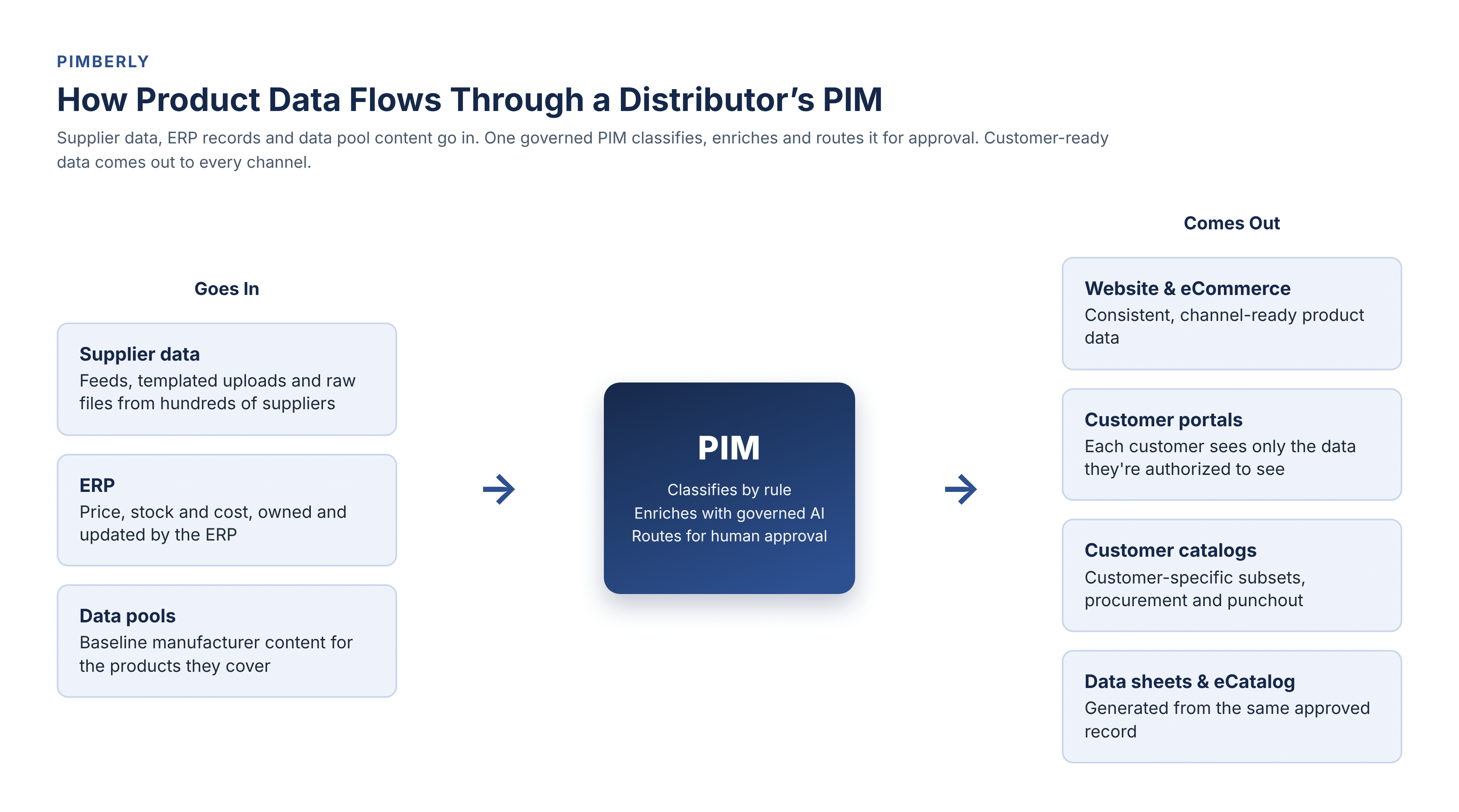
Most distributors need both, not one instead of the other. A data pool supplies baseline manufacturer content for the products it covers, built from what manufacturers choose to submit. A PIM takes that pool content, merges it with what your suppliers send you and whatever you add yourself, fills in the gaps, classifies it, enriches it, routes it for approval and publishes it by channel.
The simplest way to frame it: PIM plus data pool, not PIM or data pool. A pool gives you a starting point for the products it covers. A PIM turns that starting point, plus everything a pool doesn’t cover, into something you can actually publish to a customer. See PIM vs ERP for how the system-of-record split works on the other side of your stack.
Bring Your Own Data to Every Demo
Bring three of your messiest supplier files to every demo, along with a 500-SKU sample to classify, the name of your ERP, and one key customer’s catalog requirements. Don’t let a vendor demo its own clean sample catalog instead.
Ask each vendor to name a live customer running on your ERP, and have them walk through how data actually moves in both directions rather than describing it in the abstract. Ask who implements the platform and who supports it once you’re live, and get the cost in writing rather than a range. Score each capability as yes, partly or no rather than a vague overall impression.
Keep the evaluation itself short. A long “questions to ask a vendor” checklist tends to produce long demos and short answers; three real files and one real customer tell you more.
Why Product Data Matters More for Distributors Right Now
Procurement portals, AI shopping tools and the business buyers behind them all read your product data before they read anything else about you, and thin or inconsistent data costs listings and sales either way. Adobe’s research on AI search, which surveys consumers rather than B2B buyers specifically, found that 59% of shoppers will abandon a brand they already prefer for an unfamiliar one the moment an AI tool recommends it instead, and 49% abandon a purchase outright after noticing AI and the brand’s own site disagree. The same logic holds for a distributor’s customer portal or catalog feed: see How PIM Is the Foundation of AI Commerce for more on what that means for your own data.
See how other distributors have built the internal case for a PIM, including the ROI numbers finance will ask for, in How Distributors Make the Business Case for PIM. If supplier intake specifically is the blocker right now, see how the Vendor Portal brings that data into one governed record before it ever reaches your catalog.
FAQs
Q: What is the best PIM for industrial distributors?
A: The best fit is the platform that takes in your suppliers’ data in the formats they actually send, classifies it by rule, connects to your ERP and publishes to each customer and channel, with AI a person reviews. Which named platform fits best depends on your supplier count, your ERP and how large your catalog already is.
Q: How do distributors onboard supplier data that arrives in hundreds of formats?
A: Most PIMs built for distribution combine three intake methods: direct feeds from your largest suppliers, a templated portal for mid-size suppliers who can follow a format, and file ingestion for everyone else. A platform that only supports one method leaves gaps once you have more than a handful of suppliers.
Q: Which PIMs integrate with Eclipse, Prophet 21 or Infor?
A: Pimberly integrates with Epicor and Infor ERP families; ask for a live customer reference on your exact system, including Prophet 21 or Infor System 21, before assuming coverage. None of the other platforms compared here name a specific ERP on their public pages, so ask every vendor to show a live customer on your own ERP.
Q: Do industrial distributors need a PIM if they already have an ERP?
A: Yes, because the two systems do different jobs. Your ERP owns cost, price and stock. A PIM owns product content: supplier data intake, classification, enrichment and the different outputs each customer and channel needs. Neither replaces the other.
Q: What is the difference between a PIM and a data pool?
A: A data pool supplies baseline manufacturer content for the products it covers. A PIM merges that pool content with your suppliers’ own files and your own data, fills gaps, classifies, enriches and publishes by channel. Most distributors need both working together.
Q: Does a PIM support ETIM or UNSPSC classification?
A: It depends on the platform, so ask for a live example rather than take a feature list at face value. Pimberly’s Decision Tables apply classification by rule, including ETIM. ETIM adoption in the US has so far concentrated in electrical distribution, so check current adoption in your own sector before assuming it’s expected.
Q: Can a PIM produce customer-specific catalogs and data sheets?
A: A PIM built for distribution should let you set what each customer sees, then generate a data sheet, a catalog subset or a print catalog from the same underlying product record rather than maintaining separate files. Ask a vendor to produce one customer’s catalog live from a single record during your demo.
Q: How much does a PIM cost for a distributor?
A: Pimberly publishes its pricing: the Regular tier starts at $36,000 a year for 50,000 SKUs with DAM included, rising by tier as SKUs, users and storage grow. See the pricing page for the full structure. Other vendors compared here don’t publish pricing, so get a written quote before you compare.
Q: How long does PIM implementation take?
A: Pimberly’s typical range is around 12 weeks for a full rollout, and a pilot limited to one product category, your top suppliers and a single channel can go live faster than a full catalog migration. Timelines for other platforms vary by catalog size and integration scope, so ask for a timeline tied to your own data, not a generic average.
Q: Is a PIM only for large distributors?
A: No. The criteria in this guide, supplier intake, classification, ERP fit, customer-specific output and governed AI, apply at any catalog size, though the right platform changes with scale. A distributor with a few thousand SKUs and a handful of suppliers may be well served by a lighter setup than one running hundreds of thousands of SKUs from 75 or more suppliers.
Fit Is Decided at the Receiving Dock
A distributor’s PIM problem starts upstream of where most comparison lists begin. The suppliers who send clean feeds were never the hard part. The platform that earns a spot on your shortlist is the one that still works when a supplier sends a spreadsheet with three missing columns and a product photo embedded in a PDF.
Pimberly built its distributor features, the Vendor Portal, Decision Tables and Source/Master Logic, around that exact problem, and we’re one of the five platforms compared here for that reason. Bring your messiest supplier file to whichever vendor you shortlist next, including us, and judge the platform by what it does with it.

"With Pimberly we are able to get rich data, right the first time."
JD Sports

A super-quick run through of the key features of Pimberly’s key PIM, DAM and automation functionality.



