What is Agentic PIM? And Why It’s Not Agentic Commerce
If you’re trying to figure out what an “agentic PIM” means, you’re not alone, and you’re not behind. Vendors have been racing to put the...

Published: May 7, 2026 Updated: Jun 4, 2026
You onboard a new supplier. A week later, a PDF spec sheet lands in your inbox. A price list follows in Excel — different column names than the last vendor. Then a Dropbox link arrives, full of product images with filenames like IMG_4391.jpg and Final_FINAL_v3.jpg. Now someone on your team has to manually reconcile all of it before a single item makes it into your ERP.
This is the norm for most distributors, not the exception. And the cost isn’t just the labor hours spent cleaning data. It’s the delay between onboarding a supplier and being able to actually sell their products. It’s the pricing errors that slip through. It’s the freight misclassifications caused by wrong weight data. It’s the ecommerce listings that go up half-finished because the images weren’t usable. Gartner estimates that organizations lose $12.9 million dollars annually on average thanks to poor data quality.
The argument here is simple: the most powerful thing you can do to improve your product data operations is to move the conversation upstream. Don’t treat supplier data cleanup as an internal problem you solve after the fact. Treat it as a supplier negotiation you win before the first purchase order.
This guide breaks down exactly what product data to request from suppliers, how to specify the format, and how to enforce standards in a way that scales — so your team spends less time cleaning data and more time growing the catalog.

Most distributors frame this as an internal challenge. They hire data specialists, build out cleaning workflows, invest in MDM software, or tag PIM implementation as a Q3 priority. All of that may be necessary — but it treats the symptom.
The root cause is structural: your suppliers built their systems for their own operations, not yours. Their item master wasn’t designed to map to your ERP’s required fields. Their image library wasn’t organized for your ecommerce platform’s ingestion specs. When you ask them to provide data in your format, you’re asking them to do work that doesn’t obviously benefit them, which means it gets deprioritized, delegated to whoever is available, and delivered inconsistently.
The distributors who solve this stop waiting for good data to arrive and start defining what good data looks like, then making it a condition of doing business. They publish a supplier data spec. They build an intake template. They establish which fields are required versus optional, and they enforce it at onboarding, not after.
That shift in posture — from reactive cleanup to proactive specification — is what separates distributors who scale their supplier base cleanly from those who scale their data problems alongside it.
Product data isn’t monolithic. Before you can specify what you need from suppliers, you need a framework for thinking about what complete data actually means. There are four distinct layers, each with different owners, different formats, and different downstream consequences when missing.
This is the data that makes a product transactable: SKUs, UPCs/GTINs, list pricing, units of measure, minimum order quantities, and lead times. It sounds basic, and it is — which is why it’s particularly damaging when it arrives inconsistently. A supplier who sends you item numbers in one format for their first product line and a different format for the next creates a reconciliation problem that compounds as your catalog grows.
Dimensions, weight, materials, certifications, country of origin, HS codes. This layer is where errors carry the heaviest financial consequence. Wrong weight data means wrong freight class, which means incorrect shipping charges. Missing certifications can block a product from regulated channels entirely. Country of origin errors create customs exposure. Unlike commercial data, errors here often aren’t caught until something expensive has already happened.
Hero images, detail shots, technical drawings, installation guides, safety data sheets. The distribution of quality here is enormous — a large manufacturer may have a full DAM with properly-named, multi-resolution assets; a smaller regional vendor may send you a folder of phone photos. The format and naming conventions you specify upfront determine whether assets are usable immediately or require a manual pre-processing step for every product in the line.
Product titles, short descriptions, long descriptions, feature bullets, search keywords, category mappings. This is the layer most distributors treat as optional at onboarding and then spend significant time recreating internally. If your ecommerce platform has a 150-character limit on short descriptions, content that arrives at 400 characters isn’t usable — it has to be rewritten. At ten products, that’s annoying. At ten thousand, it’s a resource commitment— otherwise, it’ll cause major channel conflict.
The table below outlines what to request, how to specify the format, and what breaks downstream if you don’t get it. Use this as a starting point for your own supplier data specs.
| Data Layer | What to Request | Example Format to Specify | What Breaks Without It |
|---|---|---|---|
| Core Commercial | SKU/item numbers, UPCs, GTINs, list price, UOM, MOQ, lead times | Structured CSV or ERP-importable Excel with locked column headers | Duplicate items, mismatched pricing, failed ERP imports |
| Technical & Specs | Dimensions, weight, materials, certifications, country of origin, HS codes | Defined units of measure (lbs not kg unless specified); cert docs as PDF | Wrong freight class, compliance failures, customs delays |
| Digital Assets | Hero images, detail shots, technical drawings, install guides | JPEG/PNG at 1500px minimum, white background, filename = SKU | Unusable ecommerce listings, manual image cleanup overhead |
| Channel-Ready Content | Short and long descriptions, bullet features, keywords, category mapping | Character count limits (e.g. 150 char short desc); no HTML in raw fields | Copy that doesn't render, SEO gaps, manual rewriting at scale |
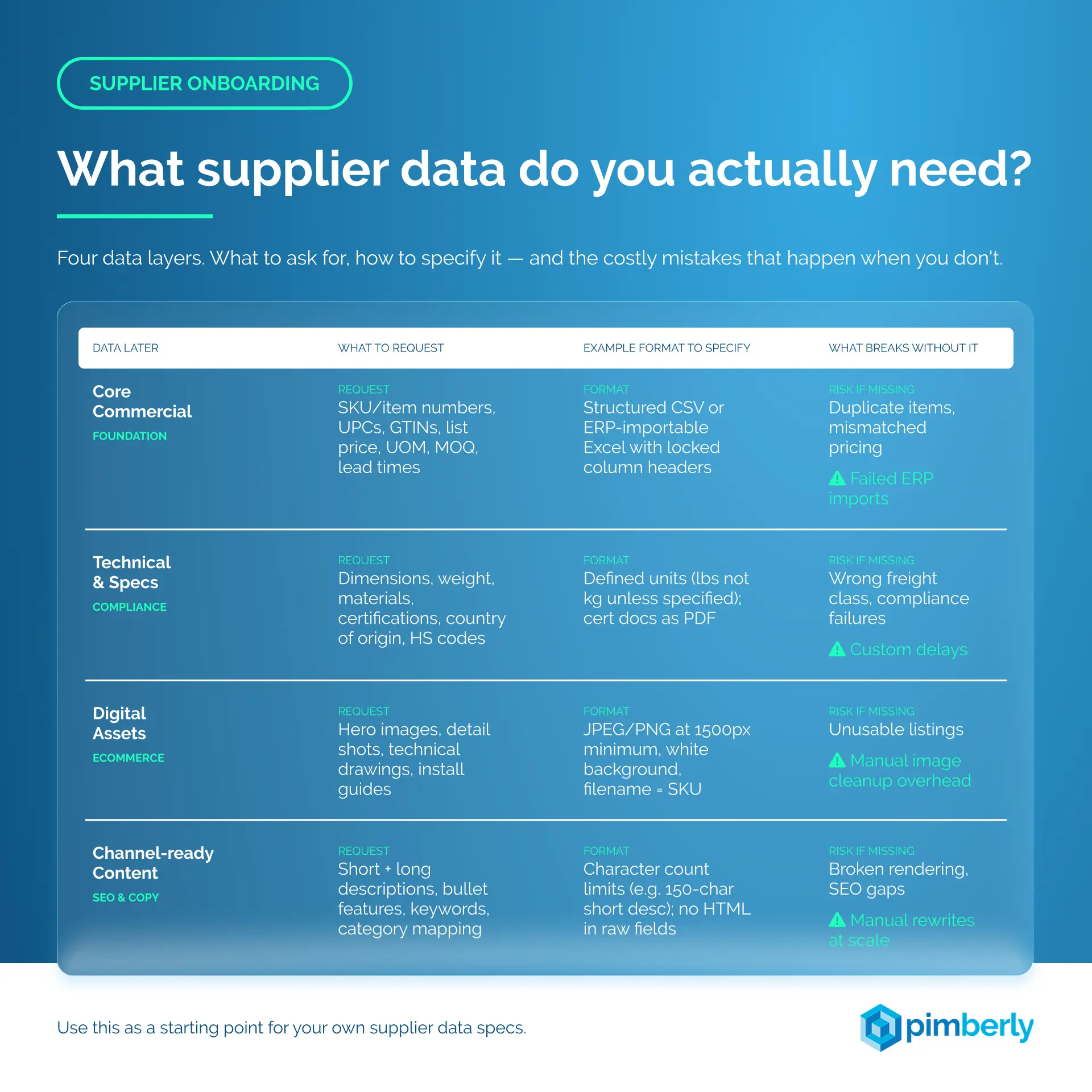
Want to share this infographic or save it for later? Download it here.
Most distributors have, at some point, sent a supplier a template and asked them to fill it in. And most have experienced the same result: the template comes back partially completed, with columns renamed, fields left blank, and data entered in ways that weren’t anticipated.
This isn’t malicious, and it usually isn’t negligence. It reflects three structural realities:
Understanding this dynamic changes how you approach the problem. You can’t fix your suppliers’ internal organization. But you can make compliance easier than non-compliance: provide a pre-formatted template with clear field definitions, offer a named point of contact for questions, build the requirement into your supplier agreement, and — critically — establish what happens to onboarding timelines when data arrives incomplete.
Not all suppliers are the same, and a one-size-fits-all data strategy will frustrate your team and your vendors. Before you send a requirements document, it’s worth assessing where a given supplier actually sits in terms of data capability.
Data comes when you chase it, in whatever format exists at the moment: a PDF, a spreadsheet, a printout from their system. There’s no structured export process. For these suppliers, the most effective approach is to give them the most constrained possible template — fewer fields, rigid structure, clear examples — and accept that there will be iteration. Build cleanup time into your onboarding SLA for Level 1 suppliers, because you’ll need it.
The data exists in their systems, but it’s not connected. Images are in one place, specs are in another, pricing lives in a spreadsheet that someone maintains manually. These suppliers can deliver what you need — they just need a clear consolidation request and a single point of contact on their side who owns it. Your job is to make the assembly as easy as possible.
They have reasonably clean, structured data and can export to a specification with modest effort. This is where a well-written supplier data spec pays off most directly: give them the format, they can deliver it. The friction is low. Your onboarding time drops substantially. The majority of mid-to-large manufacturers operate at this level or can get there quickly.
They have a PIM, EDI feeds, or API integrations and can deliver product data programmatically and at scale. For distributors with the technical infrastructure to receive it, this is the ceiling — new products flow automatically, updates propagate without manual intervention, and your team focuses on exceptions rather than entry. This is where the industry is heading, and it’s worth building your systems with this integration path in mind even if most of your current suppliers aren’t there yet.
There’s an honest tension here. Distributors often feel they can’t push back on suppliers they need — especially when the supplier is large, the margin is good, or the relationship is established. Issuing a data requirements document feels like picking a fight.
The reframe: you’re not imposing a burden. You’re defining the conditions under which you can actually sell their products effectively. Incomplete data means slower time-to-market, reduced content quality, and downstream operational costs — all of which reduce how effectively you represent that supplier’s line.
In practice, enforcement doesn’t require confrontation. It requires policy. Define in your supplier onboarding agreement which data fields are required before a product can be listed. Build into your timeline that products with incomplete data are held from publication. When a supplier sees that their products aren’t going live because assets aren’t delivered to spec, the incentive structure changes.
Start with new suppliers, where expectations aren’t yet set. Once the process is normalized, applying it to existing suppliers becomes significantly easier.
If you’re building this from scratch, the single most valuable thing you can do this week is map your ERP’s required fields for a new item record. Every field your system requires to create an item is a field your supplier must provide. That list becomes the floor of your supplier data spec.
But an ERP alone wasn’t designed to handle the full scope of modern product data. It stores transactional and operational records — it doesn’t manage rich content, digital assets, or the kind of channel-ready product information your ecommerce and sales channels need.
That’s where a PIM system earns its place. Think of the two as complementary: your ERP handles what you buy and sell, your PIM handles how you present and distribute it. Supplier data that flows cleanly into both is what makes your catalog actually scalable.
The distributors who get this right build their supplier intake process with both systems in mind — specifying not just the commercial and technical fields their ERP requires, but the descriptions, images, and content attributes their PIM will manage and syndicate downstream. That means fewer handoffs, less manual reformatting, and a much shorter runway from supplier onboarding to live, sellable products.
The template you give suppliers, the requirements you put in your onboarding agreement, and the timelines you tie to data completion — all of it gets easier when you’re clear on where the data is going and what it needs to do when it gets there. That clarity is what turns supplier data from a recurring operational problem into a competitive advantage.

A super-quick run through of the key features of Pimberly’s key PIM, DAM and automation functionality.





