
Key Takeaways
- ERP and PIM serve fundamentally different roles: ERP manages operational data, while PIM manages the product information needed to market and sell products
- Construction product data is highly complex, requiring detailed specifications, certifications, documentation, and channel-specific formatting
- Common ERP limitations include rigid data structures, poor asset management, weak support for product relationships, and lack of channel syndication
- Using PIM alongside ERP enables faster product onboarding, better search and discovery, and stronger digital customer experiences
- For construction businesses scaling digitally, a combined ERP and PIM approach is critical to managing complexity and driving growth
What Is the Difference Between PIM and ERP?
At a high level, ERP and PIM do different jobs.
An ERP system is built to manage operational and transactional processes such as purchasing, inventory, pricing, finance, orders, and supply chain activity whereas a PIM solution is designed to manage product information for supporting, selling, and marketing products across internal and external channels. This includes descriptions, attributes, specifications, categories, images, documents, relationships, translations, and channel-ready outputs.
In simple terms:
- ERP manages the business of the product
- PIM manages the information needed to sell the product
This distinction matters enormously in construction, where products are often technical, documentation-heavy and difficult to represent consistently across channels.
Why Construction Product Data Is So Hard to Manage
Construction product data is rarely simple where a single product may require management of:
- Technical specifications
- Dimensional data
- Material composition
 Performance characteristics
- Fire, acoustic or thermal ratings
- Compliance and certification details
- Installation instructions
- Environmental data
- Variants and pack sizes
- Accessories and compatible products
- Product images and brochures
- Channel-specific descriptions and classifications
On top of that, construction businesses often sell through merchants, distributors, buying groups, eCommerce sites, specification platforms, marketplaces, and internal sales systems. Each requires a different presentation of the same core data.
This creates significant pressure on product data management. If that data lives only in ERP, teams often struggle to maintain completeness, consistency, and commercial usability.
What ERP Does Well for Construction Businesses
ERP plays a critical role in construction businesses and should remain central to operations and is the right place to manage:
- SKU and item master records
- Inventory availability
- Procurement data
- Supplier records
- Pricing and costing
- Order processing
- Financial data
For many businesses, ERP is the system of record for core operational data, and it is trusted, structured and deeply integrated into back-office workflows and that is why ERP is essential, but it is insufficient for modern product data requirements for downstream ecommerce.
Where ERP Falls Short for Product Data Management
ERP is not usually designed to manage rich, omnichannel, customer-facing product content at scale and this becomes obvious in the construction sector where product information is technical, nuanced and heavily documentation-driven.
Typical limitations of ERP for construction product data include:
- Limited support for rich product content: ERP systems are generally not built for long-form descriptions, SEO content, digital merchandising, or tailore


- Weak attribute modeling: Construction products often require flexible, category-specific attributes. ERP item masters are usually too rigid to support the level of detail needed for filters, faceted search and product comparison.
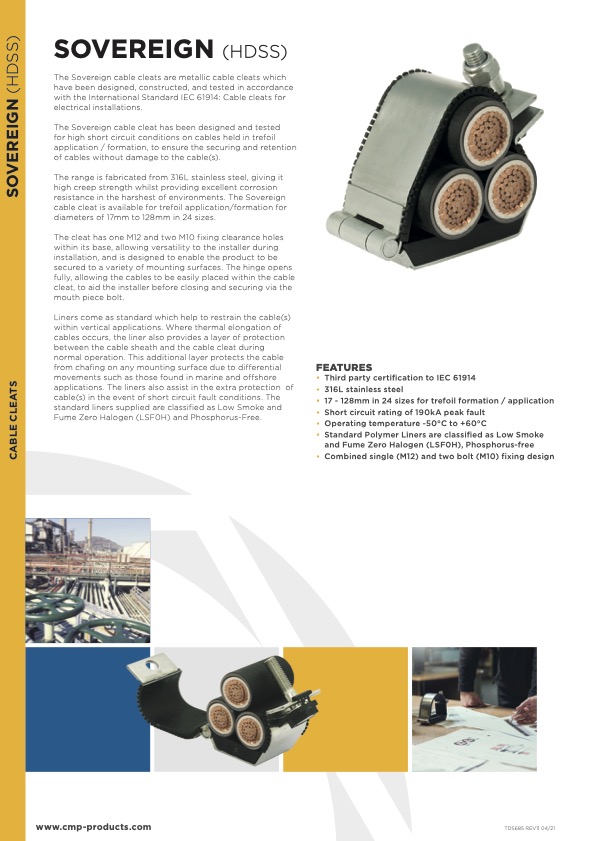
- Poor asset and document management: Datasheets, certifications, installation guides, declarations of performance, BIM files and product imagery are often stored outside ERP in shared folders or separate systems, creating fragmentation.
- Difficulty managing variants and relationships: Products may have multiple dimensions, finishes, grades, sizes, compliance options or compatible accessories. ERP can store some of this, but often not in a way that supports a strong buyer experience.
- No easy channel syndication: ERP is not usually built to tailor product data for websites, merchant portals, marketplaces, print catalogs or partner feeds.
- Slow enrichment workflows: When marketing, product and eCommerce teams rely on ERP alone, enriching content becomes manual, slow and disconnected from digital publishing needs.
This is why businesses often feel that their ERP contains product data but still does not give them control over product information.
How PIM Improves Construction Product Data
A PIM for construction gives businesses a dedicated platform for structuring, enriching, governing, and distributing product information and rather than replacing ERP, PIM complements it by solving the product-data problems ERP was not built to address.
- Centralizes product information: PIM brings together product data from ERP, suppliers, spreadsheets, technical documents, and other systems into a single environment for product content management.
- Supports complex technical attributes: Construction businesses can create structured product models with the right attributes for each category, whether that is insulation, fixings, doors, flooring, roofing, HVAC, or lighting.
- Improves data quality and completeness: PIM helps enforce data standards, validation rules, and completeness requirements so that products are ready for publication and easier for customers to understand.
- Connects assets and documentation: Product images, brochures, declarations, certifications, installation instructions, and technical sheets can be linked directly to the product record.
- Manages variants and relationships: A PIM makes it easier to handle related products, replacement products, accessories, pack sizes, and parent-child relationships.
- Enables omnichannel syndication: A PIM allows businesses to publish the right version of product data to each channel without losing control of the core data.
- Supports better search and discovery: Structured attributes make it easier to power navigation, filters, product comparison, and onsite search, all of which are particularly important in construction categories.
PIM vs ERP: Why Construction Businesses Need Both
The real answer to PIM vs ERP for construction product data is that most businesses need both. With each system doing what it does best, the ERP should remain the operational backbone for transactional and commercial records while the PIM is the product content hub that transforms raw item data into rich, accurate, channel-ready product information.
A typical PIM and ERP model looks like this: 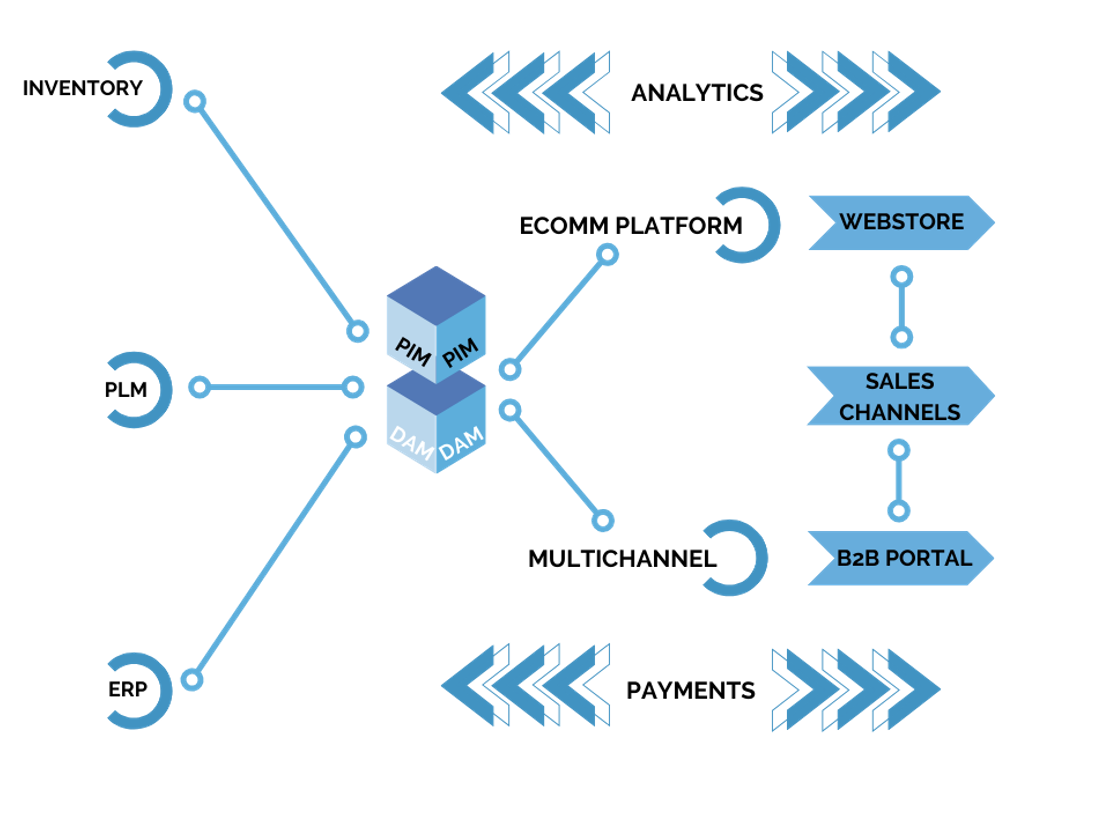
- ERP holds SKU, stock, price, supplier, and operational data
- PIM enriches that data with attributes, descriptions, assets, documents, taxonomy, relationships, and channel outputs
- Commerce, marketplaces, and sales tools consume the enriched product data from PIM
This model gives construction businesses better governance, faster updates, and a stronger digital customer experience.
When Should a Construction Business Invest in PIM?
A construction business should seriously consider PIM when:
- Product data is spread across ERP, spreadsheets, and shared folders
- Teams manually rework product content for different channels
- Technical specifications are inconsistent or incomplete
- Product onboarding takes too long
- Search and filtering on the website are weak
- Documentation is hard to manage
- Supplier data is difficult to standardize
- The business wants to expand digitally or support AI-driven discovery
If any of those challenges sound familiar, using ERP with spreadsheets is no longer sufficient for product data management.
PIM and ERP: Two Critical Components of a Construction Business’s Tech Stack
ERP is indispensable for running a construction business, but it is not the right standalone solution for managing complex construction product data. Construction product businesses need more than item records and operational data, they need structured attributes, rich content, linked documentation, channel-ready outputs and strong governance across thousands of SKUs and multiple categories. That is where PIM adds real value.
The question is not whether ERP matters. It absolutely does. The question is whether ERP on its own can support the quality, flexibility and scale required for modern construction product data. In most cases, the answer is no. For construction manufacturers, distributors and merchants, PIM and ERP are complementary systems. ERP runs the business. PIM helps support and sell the product.

A super-quick run through of the key features of Pimberly’s key PIM, DAM and automation functionality.

"With Pimberly we are able to get rich data, right the first time."
JD Sports




