How to Get Products Recommended by AI Agents
Shopping agents are not a future feature anymore, and getting products recommended by AI agents now comes down to one thing: data they can verify...
Published: Jun 8, 2026 Updated: Aug 11, 2026
AI is very good at producing a convincing answer. That is not the same thing as producing governed, trusted product data — and if you’ve tried using AI to enrich your catalog, you’ve probably already found that out the hard way.
This isn’t a niche problem anymore. AI is now a routine part of most operational workflows — McKinsey’s 2024 State of AI research found that 65% of companies already use generative AI regularly in at least one business function. Product data enrichment isn’t a McKinsey category, but it’s a natural extension of the trend: attribute enrichment, description generation, and image tagging are now standard, built-in features across most modern PIM platforms, not add-ons or experiments.
Which means the question for product data teams has quietly changed. It’s no longer “should we use AI to enrich our data” — that decision has largely been made. The real question is what separates the organizations getting reliable, governed output from the ones getting a catalog full of confident-looking guesses. And the answer isn’t a better model. It’s whether AI enrichment is applied consistently, org-wide, with real constraints and parameters around it — or left to individual teams improvising their own prompts with no shared schema, validation, or oversight.
The problem isn’t that AI can’t extract product data. It’s that most teams never set it up to extract data they can actually trust. Here’s why that gap opens up, what it looks like in practice, and what separates AI enrichment that scales safely from AI enrichment that quietly poisons your catalog.
A few years ago, “our PIM uses AI to enrich product data” was a differentiator worth putting on a sales call. It isn’t anymore.
Attribute completion, description generation, and image tagging are now baseline features across most modern PIM platforms, and most product data teams already have some form of AI touching their catalog, whether that’s a sanctioned workflow or someone quietly running descriptions through a chatbot on the side.
That shift changes what actually separates high-performing product data teams from the rest. It’s no longer access to AI. Everyone has that now. It’s whether AI enrichment is governed the same way everywhere it’s used — the same schema, the same validation rules, the same review process — or whether it’s a patchwork of individual habits with no shared constraints.
Teams that treat AI enrichment as a controlled, org-wide process end up with a catalog they can actually stand behind. Teams that let it spread informally, team by team, prompt by prompt, end up with exactly the kind of quiet, convincing errors this post opens with.
Here’s a small example that shows exactly how AI enrichment goes wrong. (To be clear: Acme Industrial and the XJ-900 are illustrative — a stand-in for the kind of supplier spec sheet every product data team sees on a weekly basis — not a real product or manufacturer.)
Below is a mockup of what that spec sheet looks like — built for this post to illustrate the scenario, not a real document from an actual supplier. The highlighted line is the one that trips AI up: it states a category of protection, but never gives an actual IP rating value.
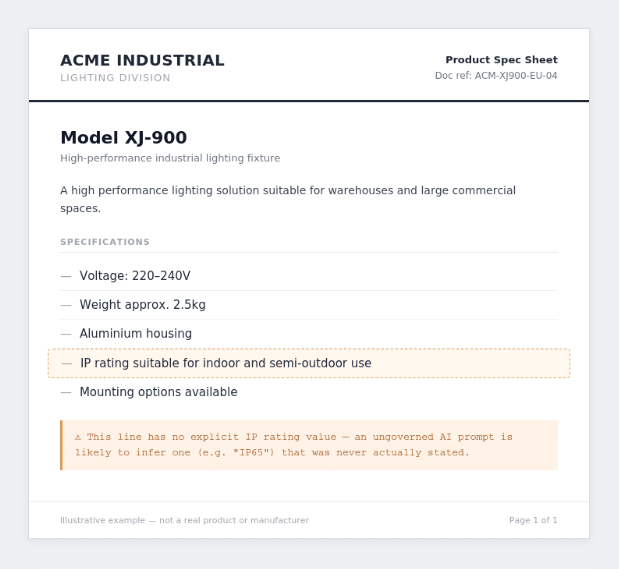
Feed a model this line from a supplier spec sheet: “IP rating suitable for indoor and semi-outdoor use.”
Ask it to extract product attributes with a loose, generic prompt, and there’s a good chance it comes back with something like ip_rating: “IP65”.
That looks great. It’s specific, it’s clean, it’s exactly the kind of structured value your PIM wants.
It’s also completely made up.
Nothing in the source text said IP65. The model inferred a plausible-sounding rating because “indoor and semi-outdoor use” is the kind of phrase that tends to appear near IP65 in the data it learned from. It wasn’t lying, exactly — it was doing what language models do, which is produce the most statistically convincing next sequence of words. That isn’t the same thing as producing the correct one.
Now imagine that value flowing straight into your PIM, out to your marketplace listings, and into a compliance field somewhere downstream. Nobody flagged it, because nothing about the output looked wrong.
That’s the trap: AI-generated errors don’t look like errors. They look exactly as confident and well-formatted as the correct data sitting right next to them.
The problem isn’t extracting data. The problem is extracting data you can trust.
Most AI product data projects don’t fail because the model is bad. They fail because the surrounding process gives the model nothing to be constrained by. Five gaps show up again and again:
1. Unstructured inputs
Product data rarely arrives as clean rows in a spreadsheet. It arrives as PDFs, parts diagrams, supplier sheets, and product images — formats an AI has to interpret rather than simply read. Every layer of interpretation is a layer where invention can creep in.
2. Vague, unclear prompts
A prompt like “extract the product attributes from this text” sounds reasonable, but it hands the model total discretion over what counts as an attribute, what to do with gaps, and how far to infer. Vague prompts produce vague — or confidently wrong — outputs, because you never told the model where the boundaries were.
3. No fixed schema
If the output isn’t required to match a fixed structure, there’s nothing forcing consistency. One product might come back with ip_rating, another with ingress_protection, another with the field simply missing. Downstream systems — your PIM, your marketplace feeds, your compliance checks — can’t safely consume data that doesn’t arrive in a predictable shape.
4. No validation
Without rules checking the output against the source, a human reviewer has no way to tell which fields are solid and which were quietly invented. Everything looks equally trustworthy, which in practice means nothing is.
5. No traceability
If a value can’t be traced back to where it came from — which page, which line, which document — there’s no way to audit it later. When something turns out to be wrong (and eventually, something will), you have no path back to the source to understand why.
None of these five gaps are about the AI model itself. They’re about what surrounds it — the instructions, the structure, the checks. That distinction matters, because it also means all five are fixable.
Compare two ways of asking the same model to do the same job on the Acme XJ-900 spec sheet referenced earlier.
A loose prompt — “please can you extract product attributes from this text” — gets you a response that looks complete. It fills in every field it can, infers where it isn’t sure, and doesn’t tell you which values were stated versus guessed. It’s fast, it’s satisfying to look at, and it’s not something you can safely put in front of a customer or a compliance system.
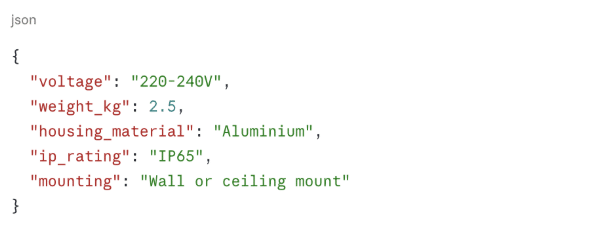
Notice ip_rating and mounting. Neither value appears anywhere in the source text. The model filled both in because they were plausible, not because they were stated — and nothing here tells you that.
A controlled version does something less impressive-looking and considerably more useful. Instead of one vague sentence, it gives the model actual boundaries:
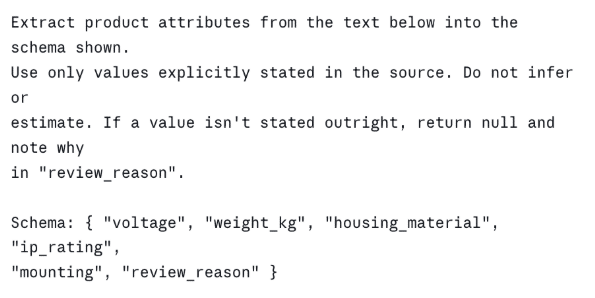
Told explicitly what it’s allowed to do and what to do when it isn’t sure, the same model produces a very different result:
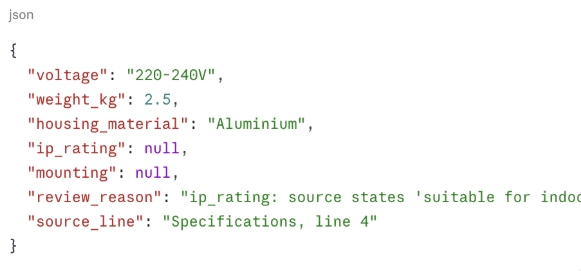
The controlled version does something less impressive-looking and considerably more useful. Built around a defined role, task, explicit constraints, a fixed schema, and examples of good and bad output, it’s told to use only explicit data and return null for anything not stated. The result comes back less “complete” — some fields empty, some flagged — and far more trustworthy. It won’t guess an IP rating that isn’t there. It’ll tell you it doesn’t know.
That second output looks worse at first glance. It’s actually the entire point. A model that fills every gap is optimizing for looking finished. A model that’s told to flag what it can’t confirm is optimizing for being right.
Good AI fills gaps. Great AI exposes them.
The difference between demo AI and enterprise AI is constraints.
If you’re running product data through AI today with anything close to “please extract the attributes from this,” you’re not really running an enrichment process — you’re running a very fast, very confident guessing machine, and hoping nobody downstream notices. Sometimes nobody does. Sometimes it’s an IP rating on a lighting fixture. The stakes only go up from there.
The fix isn’t to slow down or abandon AI for product data — it’s to give it structure it can’t wander outside of, starting with how you write the prompt itself.
Next: the five-part framework — role, task, constraints, schema, and examples — that turns “please extract the attributes” into something a PIM team can actually trust at scale, plus how to handle the harder case of pulling structured data out of messy, unstructured supplier PDFs.

A super-quick run through of the key features of Pimberly’s key PIM, DAM and automation functionality.





